What happens before a massage can influence how you experience the massage itself.
Imagine arriving at an appointment after rushing through London traffic, answering emails, checking messages and thinking about everything you need to do tomorrow.
Your body may be lying on the massage table, but your attention could still be somewhere else entirely.
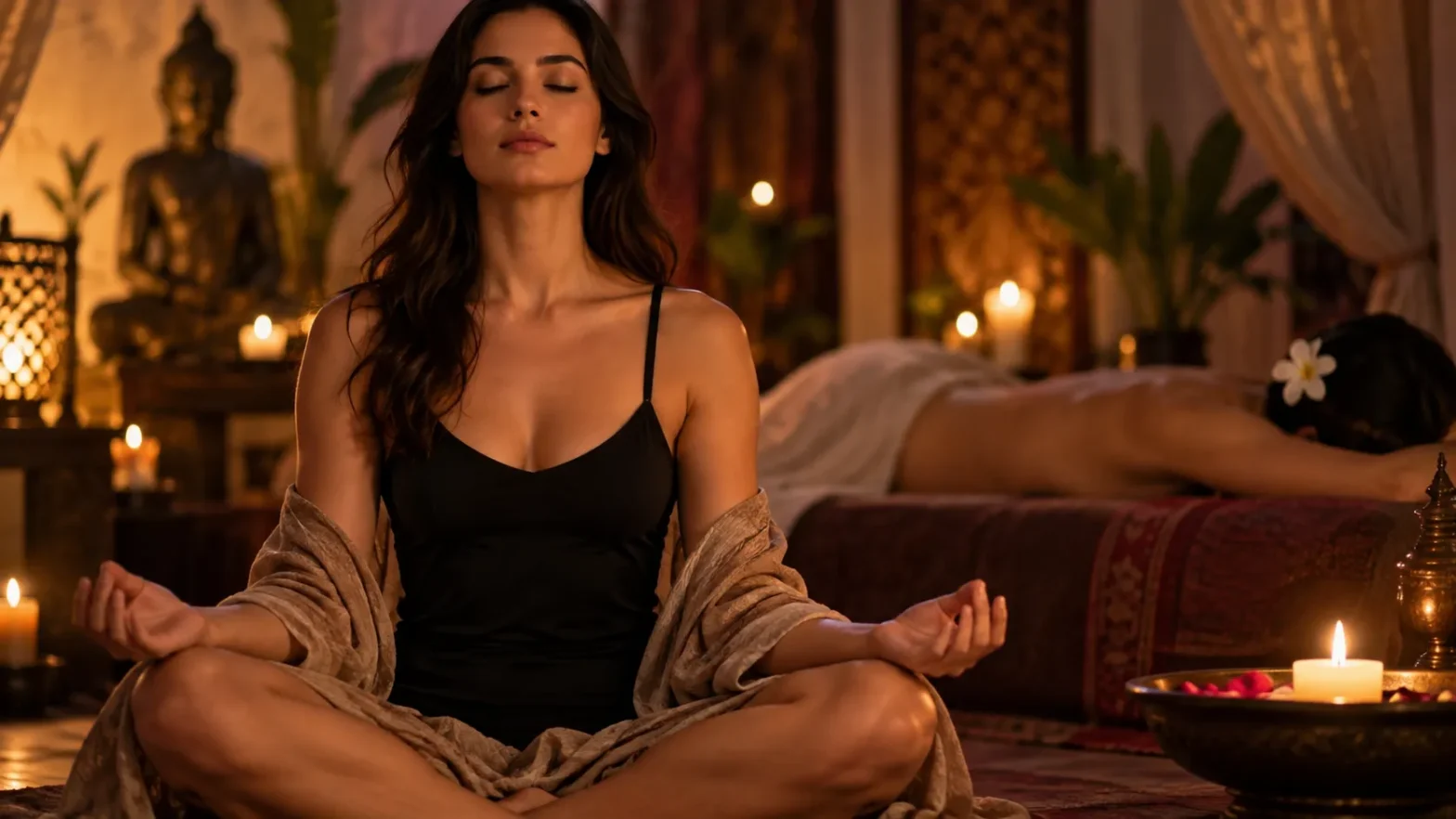
Meditation offers another way to arrive.
A few minutes of quiet breathing, body awareness and deliberate attention can create a transition between everyday activity and a slower massage experience.
This is particularly relevant to modern tantric massage, where presence, mindful awareness and sensory attention are often considered part of the experience.
You do not need to meditate for an hour.
You do not need to believe in a particular spiritual philosophy.
And you do not need to force yourself into a mystical or altered state.
For many beginners, the most useful tantric meditation is simply a structured way of becoming quieter, more attentive and more aware of what is happening in the present moment.
This guide explains how adults can use meditation before and during a tantric massage, what elements come from traditional Tantra and what belongs more accurately to modern neo-Tantric practice, and how to prepare if you are considering a professional tantric massage in London.
What Is Tantric Meditation?
There is no single practice that can accurately be called the one universal “tantric meditation.”
Tantric traditions developed over centuries and included diverse systems of philosophy, ritual, meditation, visualisation, mantra, yoga and other forms of mental and physical cultivation.
Modern scholarship treats Tantra as part of a complex historical landscape rather than a single sexual technique or massage method.
That distinction matters.
Today, especially in Western wellness and intimacy settings, “tantric meditation” may describe practices involving:
- awareness of breathing;
- focused attention;
- bodily sensation;
- visualisation;
- mantra;
- mindfulness;
- intention;
- partner awareness;
- sensory attention.
Some of those techniques have parallels within historical Tantric systems.
Others are modern adaptations.
And contemporary tantric massage itself is substantially more recent than the ancient religious traditions from which it borrows terminology and inspiration.
For a massage client, you do not need to master that entire history.
You simply need to recognise that meditation is the deeper historical component; modern tantric massage is a contemporary practice influenced by selected Tantric and neo-Tantric ideas.
Tantra Is Much Broader Than Sexuality
One of the most persistent misunderstandings surrounding Tantra is that Tantra is simply another word for sex.
It is not.
Historical Tantric traditions included sophisticated systems of ritual, meditation, philosophy and spiritual practice.
Sexual practices existed in some traditions and contexts, but reducing the entire history of Tantra to sexuality gives a distorted picture.
Modern neo-Tantra developed much later and commonly places greater emphasis on relationships, embodiment, sensuality, intimacy and personal development.
Professional tantric massage in contemporary London normally belongs much more closely to this modern world than to the formal ritual practices of medieval South Asian Tantra.
Understanding that difference helps avoid exaggerated statements such as “this exact massage ritual is thousands of years old.”
A more responsible description would be:
Modern tantric massage is a contemporary bodywork practice influenced by selected ideas associated with Tantra, including awareness, intentionality, breathing, embodiment and mindful attention.
Why Combine Meditation With Massage?
A massage is fundamentally a sensory experience.
You notice pressure.
Temperature.
Movement.
Stillness.
Sound.
The texture of oil.
The support underneath your body.
Your breathing.
Your emotional response to receiving touch.
Meditation can provide a framework for paying attention to those experiences.
That does not mean meditation makes your skin physically develop more sensory receptors or guarantees that every sensation becomes dramatically stronger.
Instead, you are changing where you place your attention.
Think about listening to music while answering emails.
The music is playing, but you may barely notice individual instruments.
Now imagine closing the laptop, putting your phone away and listening to the same piece with your full attention.
The recording has not changed.
Your relationship with the experience has.
Meditation before massage can work in a similar way.
What Does It Mean to “Intensify” a Tantric Massage?
The word “intensify” can easily be misunderstood.
For this guide, it does not mean making the massage more extreme.
It means making yourself more available to the experience.
You may notice subtler differences in pressure.
You may become more aware when you tense your shoulders.
You may realise that you prefer silence to music.
You may recognise when your breathing becomes shallow.
You may become better able to communicate when something feels particularly comfortable—or when it does not.
That kind of awareness can make a massage feel richer without requiring the therapist to constantly increase stimulation.
A useful principle is:
Greater attention can sometimes be more valuable than greater intensity.
Meditation Is Not a Performance
A common beginner mistake is trying too hard to meditate correctly.
You sit down.
You tell yourself to stop thinking.
Within seconds, you are thinking about whether you have stopped thinking.
Then you decide you are bad at meditation.
That is unnecessary.
Meditation does not require an empty mind.
Thoughts will appear.
You may think about work.
You may hear traffic.
You may wonder whether the massage will be enjoyable.
You might feel nervous.
The practice is simply noticing that your attention has wandered and bringing it back to whatever anchor you have chosen.
That anchor might be your breath.
It might be physical sensation.
It might be sound.
You are practising returning, not trying to become thoughtless.
Practice 1: Simple Breath Awareness
Breathing is one of the easiest anchors because it is always available.
Sit comfortably.
You can use a chair.
There is no requirement to sit cross-legged or adopt an advanced yoga posture.
Let your shoulders settle.
Notice one normal breath.
Then another.
Avoid forcing the breath to become unusually deep.
Simply notice the sensation of breathing in and breathing out.
Where do you feel it most clearly?
Around the nose?
Chest?
Abdomen?
There is no correct answer.
When your attention wanders, notice that it wandered and return to your next breath.
Try this for two or three minutes.
That alone can function as useful pre-massage meditation.
Why keep the breathing natural?
Tantric and yogic traditions include many specialised breathing practices, but beginners do not need breath retention, rapid breathing or intense pranayama before a massage.
Complex breathing techniques have their own contexts and are better learned appropriately.
For simple massage preparation, calm natural breathing is enough.
The aim is awareness, not respiratory achievement.
Practice 2: A Short Body Scan
A body scan moves attention gradually through the body.
It can be particularly useful before massage because it gives you a baseline.
You notice how you feel before anybody starts working with you.
Sit or lie comfortably.
Notice your feet.
You do not need to visualise anything complicated.
Simply observe whatever is present.
Warmth.
Coolness.
Pressure from the floor.
Tingling.
Nothing particularly noticeable.
Move your attention upward toward the legs.
Then the hips.
Abdomen.
Chest.
Hands.
Arms.
Shoulders.
Jaw.
Face.
As you move through the body, avoid immediately deciding that every sensation needs to change.
You are gathering information.
Perhaps one shoulder feels tense.
Perhaps your jaw is clenched.
Perhaps one leg feels more comfortable than the other.
This information may help you understand your preferences during the massage.
Practice 3: Sensory Awareness Meditation
Tantric-inspired practice often gives sensory awareness a central role.
You can explore that principle without complicated spiritual terminology.
Sit quietly for approximately five minutes.
First notice sound.
What can you hear without naming everything as pleasant or annoying?
Then notice temperature.
How does the air feel against your skin?
Notice where your body contacts the chair or bed.
Notice any fragrance in the room.
Open your eyes and notice colour, light and shadow.
Finally, bring attention back to the whole body.
This practice can be especially useful if you spend much of the day looking at screens or moving quickly between tasks.
It changes your mode of attention from analytical to sensory.
That transition can complement massage particularly well.
Practice 4: Intention Setting
An intention is different from an expectation.
An expectation says:
“This massage must make me feel a particular way.”
An intention says:
“I would like to stay curious and present during this experience.”
The difference may appear small, but psychologically it changes the session.
Rigid expectations encourage you to constantly evaluate what is happening.
Is this relaxing enough?
Am I feeling enough?
Is this better than last time?
Should something dramatic be happening now?
An intention gives you direction without requiring a predetermined outcome.
Useful pre-massage intentions might include:
“I want to notice when I am holding unnecessary tension.”
“I want to communicate clearly.”
“I want to experience the session without rushing ahead mentally.”
“I want to remain curious about what I enjoy.”
“I want to give myself permission to rest.”
Choose one.
There is no need to repeat ten intentions.
Practice 5: Visualisation
Visualisation appears in many meditation traditions, including Tantric ones.
Historical forms can be sophisticated and may involve deities, sacred geometry, mantra and highly specific ritual systems.
You do not need to imitate those practices without understanding their cultural or religious context.
For massage preparation, simple secular visualisation is sufficient.
Close your eyes.
Imagine arriving somewhere you associate with stillness.
It might be a quiet coastline.
A woodland.
A familiar room.
Do not worry about creating a perfect mental picture.
Notice the imagined light.
Temperature.
Sounds.
Then imagine your breathing remaining steady.
After a few minutes, let the image fade and return attention to the room you are actually in.
The purpose is not to escape reality.
It is to practise directing attention deliberately.
Practice 6: A Simple Mantra
Mantra has a deep and complex place within several Indian religious traditions.
Traditional mantras should not simply be treated as decorative wellness phrases stripped from their context.
Fortunately, you do not require Sanskrit to use repetition as an attention exercise.
Choose a simple phrase in your own language.
For example:
Here, now.
On the inhale, silently think:
Here.
On the exhale:
Now.
Continue for several breaths.
If another phrase feels more natural—such as “slow down” or “be present”—use it.
The effectiveness of this exercise for massage preparation comes from repetition and attention, not from pretending the phrase possesses supernatural powers.
Practice 7: Open-Eye Awareness
Meditation does not always require closed eyes.
Choose a neutral object in front of you.
A plant.
A candle that has been positioned safely.
A piece of artwork.
A point on the wall.
Let your gaze remain soft rather than staring aggressively.
Notice shape.
Colour.
Light.
Shadow.
When your thoughts wander, return your attention to seeing.
This is useful for people who find closed-eye meditation uncomfortable.
You are allowed to meditate in a way that feels safe and manageable.
Partner Meditation Before an At-Home Massage
Couples exploring massage at home can also meditate together.
Keep the practice simple.
Sit opposite each other comfortably.
Remain fully clothed if that feels more natural.
Spend one minute noticing your own breathing.
Then become aware that another person is sitting in front of you.
You may choose comfortable eye contact, but neither person should feel required to maintain it.
Talk briefly about the massage before beginning.
Ask:
What would feel relaxing tonight?
Is there anywhere you do not want touched?
Would you like conversation or mostly silence?
Would you prefer lighter or firmer pressure?
Would you like the massage to remain simply a massage?
This conversation may be more valuable than any elaborate ritual.
Tantric practice should not be used to bypass ordinary consent.
If anything, greater awareness should improve communication.
A 10-Minute Meditation Before Tantric Massage
You do not need a long spiritual ceremony before a professional appointment.
Try this ten-minute structure.
Minute 1: Stop
Put your phone away.
Sit comfortably.
Acknowledge that you are shifting from ordinary activity into personal time.
Minutes 2–3: Notice your breath
Do not manipulate it.
Feel several natural inhalations and exhalations.
Minutes 4–5: Scan the body
Notice your feet, legs, abdomen, shoulders, jaw and face.
Where are you holding tension?
Do not force it away.
Simply notice.
Minutes 6–7: Notice your senses
What can you hear?
How does the room feel?
What physical sensations are already present?
Minute 8: Set one intention
Choose one sentence.
For example:
“I will stay curious and communicate clearly.”
Minute 9: Let expectations go
Remind yourself:
“I do not need a particular outcome.”
Minute 10: Return
Take one comfortable breath.
Open your eyes if they were closed.
Continue with your day or appointment.
This is enough.
Meditation does not become more authentic simply because it is longer.
A Longer 20-Minute Home Practice
If you have more time before leaving for your appointment, use a longer structure.
Spend approximately five minutes with normal breath awareness.
Then spend five minutes scanning the body.
Spend another five minutes with sensory awareness.
Finish with five minutes of quiet sitting and intention setting.
If your mind is especially busy, consider walking slowly for a few minutes before sitting.
Movement can make stillness easier.
Avoid turning the practice into another deadline.
If twenty minutes makes you late and stressed, meditate for three minutes instead.
Should You Meditate Immediately Before the Massage?
You can, but you do not have to.
Some people prefer meditating at home before travelling.
Others find London transport immediately destroys their carefully cultivated sense of calm.
A practical alternative is to leave slightly more travel time than usual and take two quiet minutes after you arrive.
If the provider has a waiting area, simply sit.
Put your phone away.
Notice your breathing.
Feel your feet against the floor.
You have already started.
How to Use Mindfulness During the Massage
Meditation does not need to stop when the massage begins.
In fact, the massage itself can become an attention practice.
You are not trying to analyse the therapist.
Instead, notice direct sensory information.
Pressure.
Warmth.
Movement.
Stillness.
Breathing.
How different areas respond.
The difference between anticipation and actual sensation.
When your mind wanders, you can gently return to what you are physically experiencing.
Use the breath as home base
If your attention becomes busy, return to natural breathing.
You do not need to synchronise perfectly with the therapist.
You do not need a complicated count.
Just notice one breath.
Notice without judging immediately
The mind may automatically say:
“That was good.”
“That was strange.”
“I hope the next part is better.”
Try occasionally replacing judgement with observation.
“Warm.”
“Light pressure.”
“Slow movement.”
“Shoulders relaxing.”
This can help you remain closer to the direct experience.
But do not meditate through discomfort
Mindfulness is not endurance.
If something hurts or feels uncomfortable, communicate.
If you want pressure changed, say so.
If you want the therapist to avoid an area, say so.
If you want the session to pause, request a pause.
Being present includes recognising discomfort rather than spiritually explaining it away.
Should You Keep Your Eyes Closed?
Only if you want to.
Closing your eyes can reduce visual distraction.
But some people feel safer or more relaxed with their eyes open.
There is no Tantric requirement that says you must remain in darkness.
Similarly, you do not need to maintain eye contact with a professional practitioner.
Some partner exercises use eye gazing, and contemporary couples meditation resources frequently incorporate it, but what is appropriate between partners at home does not automatically belong in a professional massage session.
Your practitioner’s boundaries and session format matter.
Can Music Help?
Possibly.
Music can provide an attention anchor and help separate the appointment from the noise of the outside world.
But music is not essential.
Some people relax better in near silence.
If music contains lyrics, you may find yourself following the words rather than physical sensation.
There is no scientifically correct tantric playlist.
The right environment is simply one that allows you to feel comfortable and attentive.
What About Incense and Aromatherapy?
Treat scent as an optional environmental preference.
A fragrance that one person finds calming may give someone else a headache.
People with asthma, fragrance sensitivity or migraine triggers may prefer an unscented environment.
Do not assume incense is required because a practice is described as Tantric.
Traditional religious use of incense and modern spa fragrance are not automatically the same thing.
Comfort comes first.
Does Meditation Scientifically Make Touch Stronger?
That claim would go beyond the current evidence.
Mindfulness research does investigate body awareness and interoception—the perception of internal bodily states.
Some studies show relationships between mindfulness practice and measures of body awareness, but recent systematic research also reports considerable uncertainty and variation in the evidence.
So a responsible claim is:
Meditation may help you direct more attention toward bodily sensations.
A less defensible claim would be:
Meditation biologically amplifies every touch sensation.
Your subjective experience may indeed feel stronger or richer because you are paying closer attention.
That is different from claiming a guaranteed physiological amplification mechanism.
What About Chakras and Energy?
This is where language matters.
Chakras, kundalini, prana and subtle-body systems have important places within various spiritual and yogic traditions.
People are free to work with those frameworks spiritually.
But a wellness article should distinguish traditional belief and metaphor from established anatomy.
You can say:
“Some Tantric and yogic traditions describe subtle energy through concepts such as chakras and prana.”
Avoid turning that into:
“Science proves that massage opens blocked chakras.”
Those are different categories of claim.
Clients who find energetic language personally meaningful can incorporate it into meditation.
Clients who do not can practise breath awareness and sensory mindfulness without adopting a spiritual framework.
Five Things Not to Do Before Your Massage
Do not force an altered state
The objective is not to make yourself dizzy, dissociated or overwhelmed.
Ordinary awareness is enough.
Do not experiment with extreme breathwork immediately beforehand
Fast breathing, prolonged breath holding or unfamiliar advanced exercises are unnecessary.
Use normal comfortable breathing unless you have learned a more specialised practice appropriately.
Do not use alcohol or recreational substances as a meditation aid
Clear awareness and communication are more valuable than chemically reducing your ability to recognise and express boundaries.
Do not decide every emotional response is spiritually significant
You may feel relaxed.
You may feel restless.
You may feel nothing dramatic whatsoever.
Not every response needs to become evidence of “energy release.”
Do not turn meditation into consent
Feeling relaxed, spiritual or emotionally open does not remove your right to change your mind.
Consent and boundaries remain active throughout the session.
What if Meditation Makes Me More Anxious?
Stop.
Meditation is widely presented as universally calming, but real experiences are more varied.
Some people become more aware of anxious thoughts when sitting quietly.
Others find closed eyes uncomfortable.
Some people with trauma histories can find particular meditation practices destabilising.
Research reviews have documented adverse experiences among a minority of meditation participants.
That does not mean meditation is inherently dangerous.
It means “keep going no matter what” is poor advice.
Try keeping your eyes open.
Reduce the duration.
Focus on external sounds rather than internal sensation.
Walk rather than sit.
Or skip the meditation entirely.
If you have significant psychological distress or a mental-health condition, meditation should not be presented as a substitute for appropriate professional care.
Does Meditation Treat Anxiety Before Massage?
There is evidence that structured mindfulness approaches may be helpful in some mental-health contexts.
But a short Tantric meditation before a massage should not be presented as treatment for an anxiety disorder.
If you simply feel ordinary first-appointment nervousness, a few quiet breaths may help you settle.
If you live with persistent or severe anxiety, seek appropriate healthcare rather than expecting massage or Tantric meditation to cure it.
Preparing for Your First Tantric Massage in London
If you are booking a professional session rather than practising at home, mental preparation is only one part of the process.
Practical clarity matters too.
Before the appointment, understand:
the location;
session duration;
price;
whether the appointment is incall or outcall;
the provider’s stated session style;
what preparation is expected;
and how boundaries are handled.
Knowing those details beforehand allows you to spend less of the appointment dealing with uncertainty.
Tantric Massage London maintains live therapist, pricing and location information separately because practitioner availability and locations can change.
Use current pages rather than relying on old blog posts for booking decisions.
Meditation Before an Incall Massage
An incall appointment means travelling to the provider’s location.
London travel itself can be stimulating.
Crowded trains.
Traffic.
Navigation.
Messages.
Timetables.
Give yourself enough time that you do not arrive already worried about being late.
Once you reach the location, allow the transition to begin.
Your meditation could be as simple as:
feet on the floor;
one slower exhale;
shoulders relaxed;
phone away;
attention in the room.
There is no requirement to perform a visible ritual in reception.
Meditation Before an Outcall Massage
With an outcall appointment, the practitioner travels to an agreed location according to the provider’s service policy.
The advantage is that you can prepare the environment yourself.
Before the therapist arrives:
reduce unnecessary work distractions;
finish phone calls;
make the room comfortable;
put away work equipment where practical;
and give yourself a few minutes between your last task and the appointment.
Do not spend twenty minutes meditating and forget the practical basics.
Mental preparation and ordinary preparation work together.
Choosing a Therapist for a Meditation-Informed Tantric Experience
Search phrases such as best tantric massage therapists in London are understandable, but “best” depends heavily on what you want.
For someone interested in mindful massage, useful selection criteria include:
Communication
Does the practitioner or booking team explain the service clearly?
Style
Does the therapist’s profile sound compatible with the experience you want?
Boundaries
Can you understand the general expectations before booking?
Experience
Does the provider describe relevant massage, bodywork or Tantra-related experience honestly?
Location
Is the incall location convenient, or is an appropriate outcall option available?
Privacy
Does the provider describe booking and personal information discreetly?
Pricing
Can you establish the expected price before the appointment?
Professionalism
Do the profile, booking conversation and website information feel consistent?
Meditation cannot compensate for a provider who gives unclear answers.
Clarity should come first.
How to Choose the Best Tantric Massage Parlor in London
A similar principle applies to venues.
Do not select a location only because the room looks atmospheric in photographs.
Evaluate the complete experience.
Is communication clear?
Is the environment clean?
Is privacy respected?
Are current therapists identifiable?
Can you understand the pricing?
Is the location convenient?
Are expectations explained?
A luxurious meditation-friendly atmosphere can improve the experience, but candles and music are not substitutes for professionalism.
Should Your Therapist Guide the Meditation?
Only if that is genuinely part of their service and they are comfortable doing so.
Do not assume every massage practitioner is also a meditation teacher.
Some may include a few quiet breaths or intention setting.
Others may begin directly with massage.
If guided meditation matters to you, ask before booking.
There is also nothing wrong with doing your own meditation separately.
A two-minute private practice beforehand may be all you need.
Can Couples Meditate Before a Professional Couples Massage?
Yes.
If you are booking a couples experience, you can practise together before leaving home or before the appointment.
Keep it simple.
Sit together for five minutes.
Notice your breathing.
Talk about what each of you wants from the experience.
Avoid comparing reactions.
One partner may become deeply relaxed.
The other may remain mentally active.
Neither response means someone is “doing Tantra wrong.”
Shared attention should increase communication, not create another standard you have to meet.
What Should You Do After the Massage?
You do not need an elaborate closing ceremony.
Give yourself a little time before immediately returning to constant stimulation.
Notice how you feel.
If something about the session worked particularly well, remember it.
Perhaps you learned that you prefer lighter pressure.
Perhaps silence was more relaxing than music.
Perhaps two minutes of breathing beforehand made a noticeable difference.
Perhaps meditation made no obvious difference at all.
All of those observations are useful.
The point is self-awareness, not proving that the practice worked.
A Two-Minute Post-Massage Reflection
Sit or stand comfortably.
Ask yourself three questions:
What did I notice physically?
What helped me remain present?
What would I communicate differently next time?
That is enough.
You can write the answers down if you find journalling useful.
Otherwise, simply notice them and continue your day.
How Often Should You Practise Tantric Meditation?
There is no required schedule.
A three-minute awareness practice used regularly may be more realistic than a complicated forty-minute ritual you abandon after a week.
You might meditate:
before massage;
before sleep;
after work;
before spending focused time with a partner;
or whenever you want to transition from mental busyness toward sensory awareness.
Consistency can make the practice more familiar.
But meditation should support your life rather than becoming another performance metric.
Do You Need a Tantra Teacher?
Not for the simple attention exercises in this guide.
Breath awareness, body scanning and ordinary sensory mindfulness can be approached gently by beginners.
If you want to study historical Tantra, complex mantra practice, advanced pranayama, subtle-body systems or a particular spiritual lineage, qualified instruction becomes considerably more valuable.
The internet often blends multiple Hindu, Buddhist, yogic and modern neo-Tantric ideas together as though they formed one universal system.
They do not.
Going deeper deserves better guidance than an SEO article.
Frequently Asked Questions
What is tantric meditation in simple terms?
Tantric meditation refers to a broad family of contemplative practices associated historically or in modern adaptations with Tantra. Depending on the tradition, practices may involve breath awareness, mantra, visualisation, bodily awareness and focused attention. Modern neo-Tantric practice often places additional emphasis on embodiment, relationships and sensory awareness.
Can meditation improve a tantric massage?
Meditation may help you become more attentive and less distracted during massage. That can make subtle differences in pressure, temperature and sensation easier to notice. It does not guarantee that every massage will feel dramatically more intense.
How long should I meditate before tantric massage?
Beginners can start with approximately five to ten minutes. Even two minutes of quiet breathing may be useful if that is all the time you have.
Should I use deep breathing before massage?
Comfortable natural breathing is sufficient. You do not need intense breathwork or long breath holds to prepare for massage.
Should I meditate before my first tantric massage?
You can, but it is optional. Meditation may help you transition away from work, travel and everyday distraction. Clear information about the appointment, therapist and boundaries is equally important.
Can I meditate during tantric massage?
Yes. Simply noticing your breathing and direct physical sensations can function as mindfulness practice during massage.
Do I need to clear my mind?
No. Minds produce thoughts. When you notice your attention wandering, gently return to the breath or bodily sensation.
Are tantric meditation and mindfulness the same?
They overlap but are not identical. Mindfulness is used in many secular and religious contexts. Historical Tantric meditation can include additional systems such as mantra, visualisation, deity practice and subtle-body concepts.
Is tantric meditation sexual?
Not inherently. Tantra is much broader than sexuality. Many meditation practices associated with Tantric traditions are not sexual.
Is tantric massage an ancient Tantric meditation practice?
Modern tantric massage is better described as a contemporary bodywork practice influenced by selected Tantric and neo-Tantric ideas. It should not be presented as though today’s commercial massage format has existed unchanged for thousands of years.
Do chakras have to be part of meditation?
No. Chakra frameworks are important within particular spiritual traditions, but you can practise simple breath and sensory awareness without using them.
Can tantric meditation cure anxiety?
It should not be presented as a cure for anxiety. Meditation and mindfulness have been studied in relation to mental health, but a short pre-massage practice is not a substitute for appropriate healthcare.
What if meditation makes me uncomfortable?
Stop or modify the practice. Keep your eyes open, shorten the session, walk instead of sitting or focus on external sensations. Meditation does not need to be forced.
What should I focus on during a massage?
Breathing, pressure, temperature, movement and your own comfort are simple anchors. You do not need to continuously analyse every sensation.
How do I find tantric massage in London?
Review current service information, therapist profiles, locations, availability and prices. Different London practitioners may use Tantric terminology in different ways, so read beyond the service name.
Who are the best tantric massage therapists in London?
There is no universal best therapist. Compare practitioners according to experience, approach, location, communication, boundaries, service style and availability.
How do I find the best tantric massage parlour in London?
Evaluate privacy, hygiene, location, service clarity, therapist choice, communication and transparent pricing rather than choosing exclusively from promotional claims.
Should I ask a London therapist about meditation before booking?
If meditation or breath awareness is important to the experience you want, yes. Ask whether those elements are part of that practitioner’s session rather than assuming every therapist uses the same format.
From Meditation to Massage: Presence Before Intensity
Tantric meditation does not have to be mysterious.
Before your next massage, sit quietly.
Notice one breath.
Feel your feet against the floor.
Notice your shoulders.
Listen to the sounds around you.
Set one simple intention.
Then stop trying to manufacture an extraordinary experience.
That may be the most useful preparation of all.
Modern tantric massage often emphasises presence, sensory awareness and an unhurried approach. Meditation can complement those qualities by helping you arrive mentally as well as physically.
It cannot guarantee bliss.
It cannot prove that invisible energy has been medically manipulated.
And it should not remove ordinary judgement, communication or boundaries.
What it can offer is something much simpler:
a way to pay attention.
For adults exploring tantric massage in London, that attention can help you recognise your preferences, communicate more clearly and experience a session without constantly anticipating what should happen next.
If you would like to explore a professional session, review Tantric Massage London’s current therapist profiles, locations and pricing before booking so you can select an experience that matches your preferences and expectations.