
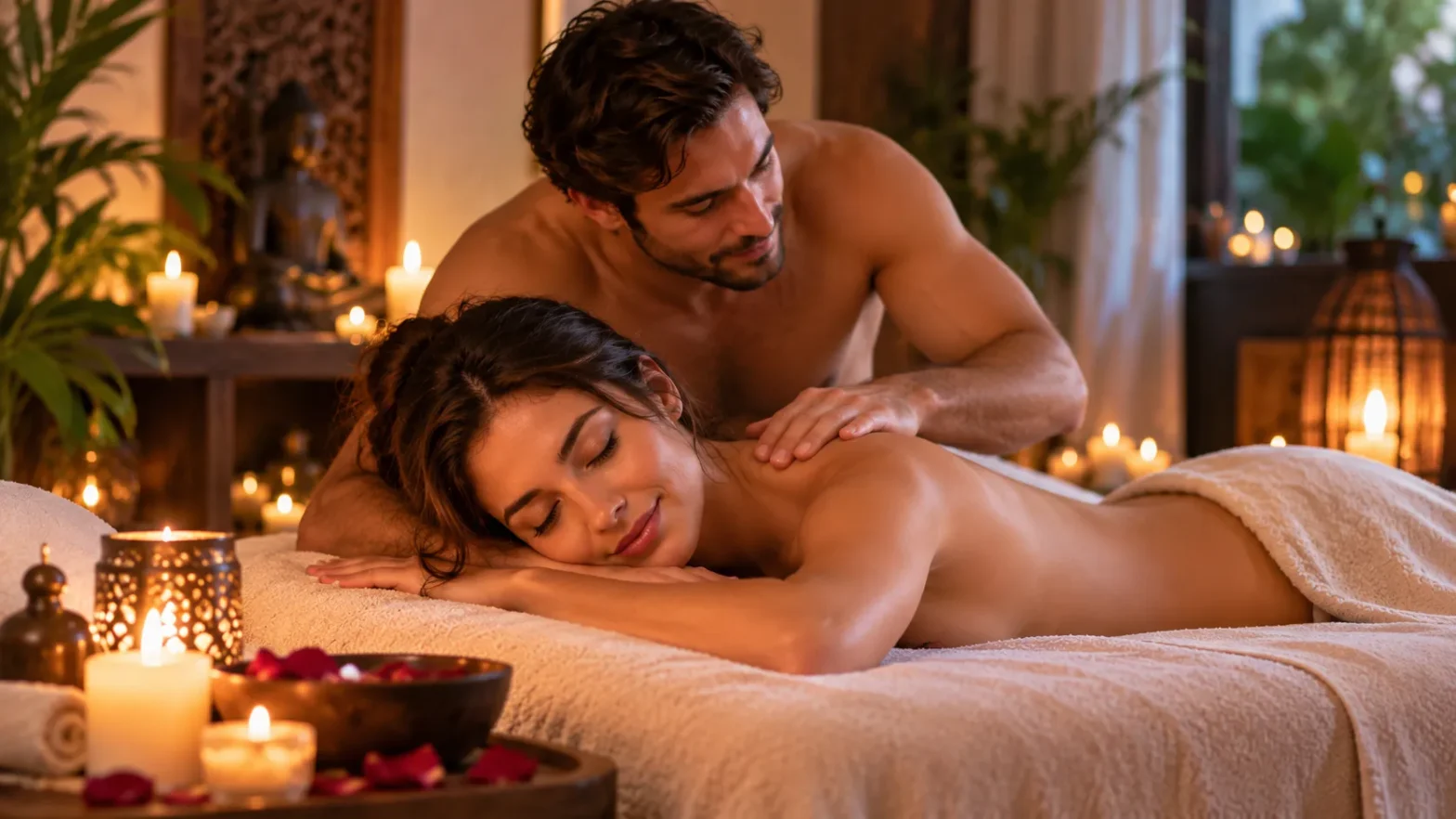
Tantric massage is often presented online as a collection of techniques. For couples, however, technique is only a small part of the experience.
A more useful starting point is presence.
Slow down. Pay attention to how your partner responds. Communicate clearly. Remove the pressure to perform. Let touch become something you experience together rather than another activity you are trying to complete correctly.
That approach captures much of what people are looking for when they search for tantric massage for couples: greater awareness, deeper communication, more meaningful physical connection and an opportunity to step outside familiar routines.
This guide is intended for consenting adults aged 18 and over. It explains how couples can explore a modern, Tantra-inspired massage ritual at home without treating intimacy as a performance or making unrealistic promises about what the practice can achieve.
It also explains how at-home practice differs from booking a professional tantric massage in London, and what to look for if you decide you would rather learn from or experience a professional practitioner.
What Is Tantric Massage?
Modern tantric massage is a broad term rather than one universally standardised massage system.
In contemporary Western practice, the name is commonly used for slow, attentive bodywork that combines elements such as mindful touch, breathing, relaxation, body awareness, intentionality and, in some settings, sensuality.
The emphasis is normally different from a conventional sports or deep-tissue massage. Instead of concentrating primarily on knots, muscles or physical recovery, the focus is usually on awareness of the whole experience.
That may include noticing the breath, becoming conscious of physical sensations, communicating about what feels comfortable and giving the receiver permission to relax without feeling that they immediately have to reciprocate.
For couples, this can create something that everyday life often makes difficult: uninterrupted time devoted to one another.
There does not need to be a particular end result.
A massage can remain simply a massage. It can become affectionate. It may lead a couple into greater intimacy if both people want that. Or it may finish with nothing more than rest and conversation.
Removing the expectation of a particular outcome is one of the most useful principles beginners can take from the practice.
Traditional Tantra and Modern Tantric Massage Are Not the Same Thing
It is worth clearing up one of the biggest misconceptions surrounding this subject.
Traditional Tantra is far broader than sexual massage.
Historical Tantric traditions developed within several South Asian religious and philosophical contexts, particularly Hinduism and Buddhism, and also intersected with Jain traditions. They included complex systems of ritual, meditation, philosophy, yoga and spiritual practice.
What is commonly called tantric massage in London, Europe and North America today is usually part of a much newer Western development often described as neo-Tantra.
Neo-Tantra takes inspiration from selected ideas associated with Tantra while often placing greater emphasis on embodiment, relationships, sexuality, conscious touch and personal development.
The distinction matters for two reasons.
First, it prevents the history of Tantra from being reduced to a sexual technique.
Second, it gives couples permission to approach modern tantric massage realistically. You do not need to pretend you are reproducing an ancient ritual exactly. You can simply acknowledge that you are exploring a contemporary practice influenced by ideas such as mindfulness, intentionality, breath and embodied awareness.
That is both more historically responsible and more useful.
Is Tantric Massage the Same as Tantric Sex?
No.
The two can overlap, but one does not automatically lead to the other.
Tantric massage is primarily about giving and receiving conscious touch. Tantric intimacy is a broader approach in which a couple may bring similar qualities—slowness, breath awareness, communication and presence—into their sexual relationship.
A useful rule is this:
Massage should never be treated as automatic consent to anything that follows.
If you have finished the massage and would like the experience to become more intimate, pause and communicate again.
A partner who was happy to receive massage has not necessarily agreed to anything else.
This distinction is especially important because relaxation can make people quieter than usual. Silence should never be interpreted as permission.
Healthy consent is ongoing and can be withdrawn at any point.
What Can Couples Realistically Gain From Tantric Massage?
The strongest benefits are often simple ones.
Time without distraction
Phones, work, children, commuting and daily responsibilities can leave couples spending plenty of time near one another without actually giving one another much focused attention.
A massage ritual creates a defined period in which that changes.
The receiver does not need to entertain, organise or reciprocate. The giver does not need to rush toward the next stage.
That simplicity can be surprisingly valuable.
More conscious communication
Many couples are comfortable discussing restaurants, holidays, money or work yet find it difficult to explain how they like to be touched.
Massage creates a relatively low-pressure opportunity to practise.
Questions such as “Would you prefer lighter or firmer pressure?” or “Would you like me to stay here or move on?” teach both people that feedback does not have to be interpreted as criticism.
Greater body awareness
Mindfulness involves noticing what is happening in the present moment without immediately judging it.
Research into sexual mindfulness has found associations between this kind of awareness and aspects of sexual and relationship wellbeing. Those findings do not prove that tantric massage itself treats relationship or health problems, but they do support the broader principle of bringing non-judgmental attention into intimate experiences.
An alternative to goal-driven intimacy
Couples can easily fall into familiar routines where physical closeness feels as though it is progressing toward a predetermined destination.
Tantra-inspired practice offers another possibility: experiencing touch without continually asking what happens next.
That can reduce some of the performance mentality that makes intimate situations unnecessarily stressful.
Shared curiosity
Long-term relationships benefit from discovering new things about each other.
The discovery does not have to be dramatic.
You might simply realise your partner prefers slower touch than you assumed, enjoys having their hands massaged, finds silence more relaxing than music, or needs more time to mentally transition out of the working day.
Those small observations can make everyday affection more attentive.
Consent Comes Before Technique
If there is one section of this guide worth remembering, it is this one.
A successful couples massage begins before either person touches the other.
Spend a few minutes establishing what the experience means tonight.
You might ask:
- Are you comfortable being massaged today?
- Are there areas you do not want touched?
- Are you experiencing pain or tenderness anywhere?
- Would you prefer to keep the experience entirely non-sexual?
- Would you like conversation, silence or occasional check-ins?
- How will you tell me if you want me to stop?
The point is not to turn a romantic evening into a legal negotiation.
The point is to remove uncertainty.
When someone knows that “stop,” “pause,” “lighter,” “not there” or “I’ve changed my mind” will be accepted immediately, they are far more able to relax.
Consent is also reversible. Agreement at the beginning does not remove either partner’s ability to stop later.
Do not attempt an intimate massage when either partner is too intoxicated to communicate and make clear decisions.
What You Need Before Giving Your Partner a Tantric Massage
You do not need an elaborate collection of equipment.
Comfort matters more than decoration.
A private space
Choose somewhere you will not be repeatedly interrupted.
The room should feel comfortably warm because people cool down quickly when resting.
A bed, padded mat or other stable comfortable surface can work.
Clean towels or sheets
Massage oil gets everywhere.
Place washable towels underneath the receiver and keep another nearby for removing excess product.
Suitable massage oil
Use something designed for skin and check the ingredients for allergies or sensitivities.
A patch test is sensible when using a new product.
Avoid heavily perfumed products if either of you has sensitive skin.
There is another important consideration if massage may be followed by sex: many oil-based products can damage latex condoms. NHS guidance recommends using water- or silicone-based lubricant rather than oil-based products with latex condoms.
Plan accordingly rather than discovering the issue halfway through your evening.
Soft lighting
You should be able to see what you are doing.
Low lighting can create a relaxed atmosphere, but the goal is comfort rather than theatrical darkness.
Candles are optional. If you use them, place them safely away from bedding, towels and massage oil.
Music—or silence
Choose what helps the receiver relax.
Instrumental music works for some people because lyrics can be distracting. Other people find even quiet music irritating.
Ask rather than assume.
Enough time
Rushing defeats the purpose.
You do not need an entire evening, but avoid beginning when one of you is watching the clock.
For beginners, approximately 45–60 minutes is enough to explore the principles without making the experience feel exhausting.
A Beginner-Friendly Tantric Massage Framework
Rather than memorising dozens of specialised movements, use the following framework.
It is intentionally simple.
Phase 1: Set an intention
Before beginning, decide what you are trying to create.
A useful intention might be:
“We are going to spend the next hour slowing down and paying attention to one another without needing anything particular to happen.”
That is very different from:
“I need to give an amazing tantric massage.”
The first intention creates curiosity.
The second creates pressure.
Phase 2: Settle together
Sit comfortably near each other for a minute or two.
You do not need a complicated ritual.
Simply allow the transition from ordinary conversation into focused time together.
Notice your breathing.
Relax your shoulders.
You can close your eyes or maintain comfortable eye contact.
The aim is not to achieve a special altered state. It is simply to arrive mentally in the same room where your body already is.
Phase 3: Let the receiver become comfortable
Have your partner settle into a position that does not strain their neck or lower back.
Use pillows where helpful.
Ask whether they are warm enough.
The person receiving should not need to remain perfectly still. Comfort takes priority over maintaining a supposedly correct position.
Phase 4: Begin with broad, neutral touch
Start away from highly sensitive areas.
Shoulders, upper back, arms, hands, calves and feet are easy places to begin.
Warm a small amount of oil between your palms before applying it.
Use broad, slow movements rather than trying to impress your partner with complicated massage techniques.
Do not assume firm pressure is better.
Some people find very light touch relaxing. Others prefer greater pressure. Ask.
Phase 5: Slow down further
Beginners often move too quickly because they feel they should be doing more.
Try doing less.
Allow one movement to finish before beginning another.
Keep one hand in contact with the receiver while repositioning when practical so the flow does not continually feel broken.
Most importantly, watch your partner rather than mentally rehearsing the next step.
Phase 6: Bring attention to breathing
You do not need forceful or unusual breathwork.
Ordinary slow breathing is enough.
The giver can consciously relax their own breathing, which often encourages the overall pace of the massage to settle naturally.
You can occasionally invite your partner to notice their breath, especially if you sense that they are holding tension.
Avoid turning breathing into another performance target.
If either person becomes light-headed or uncomfortable, return to normal breathing.
Phase 7: Vary the quality of touch
Instead of concentrating only on pressure, experiment with contrasts.
Your palms create a different sensation from your fingertips.
A long continuous movement feels different from a brief stationary hold.
Stillness can sometimes feel as meaningful as movement.
The point is not to create maximum stimulation. It is to help the receiver notice a wider range of sensation.
Phase 8: Check in without breaking the atmosphere
Communication does not destroy intimacy.
A quiet “How is the pressure?” can improve the experience far more than twenty minutes of guessing.
You can use a simple three-option system:
More — Same — Less.
Ask whether your partner wants more pressure, the same pressure or less.
You can use the same framework for speed or for how much conversation they want.
Phase 9: Let the experience develop naturally
Do not constantly search for signs that your partner is becoming sufficiently relaxed, emotional, connected or aroused.
Bodies respond differently from day to day.
Sometimes the receiver may feel deeply relaxed.
Sometimes they may become restless.
Sometimes they may laugh.
Sometimes their mind will keep wandering back to work.
None of those responses means the massage has failed.
The practice is noticing what is happening without forcing it to become something else.
Phase 10: Finish gradually
Do not end abruptly.
Gradually make your movements slower and simpler.
Then allow a few moments of stillness.
Cover your partner with a towel or blanket if they want one.
Give them time to sit up.
Offer water.
You do not need to immediately analyse the experience.
Let the transition back into ordinary conversation happen at its own pace.
How Can Tantric Massage Lead Into Tantric Sex or Deeper Intimacy?
The transition should be intentional rather than assumed.
If the massage has created a feeling of closeness and both partners would like to continue, pause.
Ask.
Something as simple as “Would you like to keep going and be more intimate, or would you rather stay here?” is enough.
If both partners choose to continue, many of the same principles still apply:
stay present;
slow down;
continue communicating;
notice breathing;
avoid treating climax as a scoreboard;
pay attention to comfort;
allow either person to change direction.
Tantric intimacy does not require a particular sexual position or elaborate ritual.
The central idea is that physical closeness can become something you pay attention to rather than rush through.
Eye contact may feel meaningful for some couples. For others it feels awkward. There is nothing wrong with that.
Synchronised breathing may feel calming. Other couples prefer natural breathing.
There is no requirement to copy somebody else’s image of Tantra.
Your practice should work for the two people actually involved.
If intercourse or another activity with pregnancy or STI risk is going to be part of the evening, use your normal safer-sex precautions. Remember that oil-based massage products can interfere with latex condoms.
A Simple 45–60 Minute Couples Ritual
Here is a beginner structure you can adapt.
First 5 minutes: arrive
Turn off unnecessary notifications.
Make the room comfortable.
Talk about boundaries and intention.
Spend a few moments simply sitting together and slowing your breathing.
Next 10 minutes: shoulders, arms and hands
Begin with familiar areas.
Use this period to discover preferred pressure and pace.
Do not rush toward more intimate touch.
Next 15 minutes: back, legs and feet
Continue using slow, broad movements.
Try to maintain consistency rather than constantly changing technique.
Let the receiver communicate whenever something feels particularly relaxing or uncomfortable.
Next 10 minutes: front of the body, according to agreed boundaries
Let the receiver change position.
Reconfirm boundaries if necessary.
Continue with areas you have already agreed are comfortable.
There is no requirement to include every part of the body.
Final 10 minutes: gradual closing
Slow your touch.
Allow a few quiet moments.
Then decide together whether you want to finish, cuddle, talk or continue into another form of consensual intimacy.
The important part is that the ending is a choice rather than an automatic next step.
Should Couples Take Turns?
You can, but you do not have to exchange massages on the same evening.
In fact, giving one person the full role of receiver can remove a subtle form of pressure.
If you know that you will have to get up and perform another hour-long massage immediately afterwards, part of your attention may stay focused on what comes next.
An alternative is to alternate evenings.
One night, one person receives.
Another time, the roles reverse.
This makes receiving without immediately reciprocating an intentional part of the practice rather than something to feel guilty about.
Choosing Massage Oil Safely
Massage oil seems like a minor detail until the wrong product causes irritation.
Choose products intended for skin contact.
If either of you has allergies, eczema, highly sensitive skin or another dermatological condition, check the ingredients carefully and consider asking a pharmacist or healthcare professional about suitable products.
Use only a modest amount.
More oil does not automatically create a better massage, and excessive oil can make surfaces dangerously slippery.
Be especially careful on tiled floors and in bathrooms.
If you expect the massage to lead into sex and you use latex condoms, do not assume the massage oil is compatible. NHS guidance specifically advises against oil-based lubricant with latex condoms.
Common Mistzakes Beginners Make
Trying to recreate something seen online
Your partner is not a demonstration model.
Copying an exact sequence is much less useful than responding to the person in front of you.
Moving too quickly
Speed usually increases when the giver becomes uncertain.
When you do not know what to do next, slow down rather than adding more.
Treating silence as consent
Relaxed people can become quiet.
Continue checking in.
Making orgasm the measure of success
One of the most useful aspects of mindful intimacy is learning that an experience can be worthwhile without a particular finish.
Turning the massage into a test of your relationship
Do not expect one evening to resolve longstanding communication problems or transform your intimacy.
It is an experience, not a relationship examination.
Promising health cures
Massage may feel relaxing and meaningful, but claims that tantric massage cures disease, eliminates trauma or medically corrects sexual dysfunction go far beyond the evidence.
Persistent pain, sexual difficulties or psychological distress deserve appropriate professional healthcare.
Overcomplicating the spiritual side
You do not need to believe in chakras, energetic anatomy or any particular spiritual system to explore mindful touch with a partner.
If those concepts are personally meaningful to you, they can form part of the experience.
They should not be presented as scientifically established medical facts.
When Should You Avoid or Postpone a Tantric Massage?
Postpone the experience when one of you is unwell, too intoxicated to communicate clearly, uncomfortable with the idea, or experiencing unexplained pain.
Also avoid massaging broken, infected, inflamed or irritated skin.
Pregnancy, recent surgery, significant injuries and certain health conditions can change what forms of massage are suitable. Seek appropriate professional guidance when necessary.
Emotional comfort matters as well.
Touch can sometimes bring unexpected feelings to the surface.
If either partner becomes distressed, stop.
Do not insist on completing the ritual.
A caring response is more important than finishing the massage.
For people with trauma histories, working with an appropriately qualified therapist may be preferable to improvising intense body-based exercises at home.
At-Home Tantric Massage vs Professional Tantric Massage in London
Giving your partner a massage at home and booking a professional session are different experiences.
At home, the advantage is familiarity.
You already know one another. You can take as much time as you want, experiment gradually and make the practice part of your relationship.
Professional massage offers something different: the receiver does not have to manage the process.
A good practitioner should be able to explain their approach, boundaries, session structure and practical expectations before you book.
For people exploring tantric massage in London, it is especially important to understand that providers may use the same terminology for very different styles of bodywork.
Some focus heavily on relaxation and mindfulness.
Others work within neo-Tantric or sensual frameworks.
Some incorporate elements of conventional massage.
The word “tantric” by itself does not tell you exactly what will happen.
Ask.
How to Choose a Tantric Massage Therapist in London
The “best” therapist is not simply the person with the most dramatic marketing.
Look for clarity.
A professional profile should help you understand where the therapist works, the general style of the session, pricing or how to obtain pricing, booking arrangements and any relevant boundaries.
You should also feel able to ask questions without being pressured.
Tantric Massage London currently maintains separate pages for available therapists, locations and pricing, which is more useful than relying on details embedded permanently in an article because practitioner availability and locations can change.
If you are comparing the best tantric massage therapists in London, consider:
- Communication: Can the therapist or booking team explain the session clearly?
- Boundaries: Are expectations discussed rather than left deliberately vague?
- Hygiene: Is the environment clean and professionally prepared?
- Privacy: Are booking and personal information handled discreetly?
- Location: Is the incall or outcall arrangement clear?
- Experience: Does the therapist’s profile explain relevant massage or bodywork experience?
- Consistency: Do the website, booking information and individual profile tell the same story?
- Comfort: Do you feel able to say no or ask questions?
The same criteria apply when choosing what searchers may describe as the best tantric massage parlor in London. Luxury décor is pleasant, but clarity, professionalism, hygiene, boundaries and communication matter more.
What Should You Expect From a Professional London Session?
Exact experiences vary according to practitioner and service.
You should therefore avoid relying on a generic online description.
Ask about the session before booking.
Useful questions include:
- How long is the appointment?
- What should I do before arriving?
- Is a shower available or expected?
- What type of massage or bodywork is provided?
- What should I wear?
- How are boundaries discussed?
- Is the session incall or outcall?
- What is the full cost?
- Are there any extra travel charges?
- What happens if I am late?
Clear answers reduce uncertainty for both client and therapist.
If you want to compare current options, use the live therapist and location pages rather than an older blog post.
Can Tantric Massage Improve a Relationship?
It can create conditions that some couples find valuable: focused attention, novelty, touch, communication and mindfulness.
That does not mean it functions as relationship therapy.
Research into sexual mindfulness has found positive associations with sexual satisfaction and aspects of relationship wellbeing, but relationships are complex, and no massage technique guarantees an emotional outcome.
If your relationship is dealing with significant conflict, coercion, pain, trauma or sexual dysfunction, appropriate counselling, medical support or qualified sex therapy may be more useful than trying to solve the problem through massage alone.
Frequently Asked Questions
How do I give my partner a tantric massage for the first time?
Begin with communication rather than technique. Agree boundaries, prepare a warm private space, remove distractions and start with slow massage of neutral areas such as the shoulders, back, arms, hands, legs and feet. Ask about pressure and remain attentive to your partner throughout.
Do I need tantric massage training to massage my partner?
You do not need professional certification to give a consenting partner a simple relaxing massage at home. However, avoid presenting yourself as a therapist or attempting specialised therapeutic techniques you are not trained to perform.
Does tantric massage have to be sexual?
No. It can remain a slow, mindful massage focused on relaxation, touch and connection.
Does tantric massage always lead to tantric sex?
No. Massage and sex are separate activities. If both partners want to become more intimate afterwards, pause and establish consent again.
What is tantric sex in simple terms?
Modern tantric intimacy generally refers to approaching sex with greater attention to slowness, breathing, sensation, communication and present-moment awareness rather than focusing exclusively on performance or climax.
Is orgasm the goal of tantric massage?
It does not need to be. Removing a predetermined goal can make it easier to pay attention to the experience itself.
How long should a couples tantric massage last?
There is no universal duration. Around 45–60 minutes is a practical starting point at home. What matters more is having enough uninterrupted time that neither person feels hurried.
What massage oil should we use?
Choose a skin-safe massage product suitable for both partners. Check for allergies or sensitivities. Remember that oil-based products can damage latex condoms, so plan appropriately if sex may follow the massage.
What if my partner becomes uncomfortable?
Stop. Ask what they need. They may want different pressure, a different area massaged, a break or to finish completely. Changing your mind is always acceptable.
What if we start laughing or feel awkward?
That is normal. Trying something unfamiliar can feel strange initially. You do not need to create a perfectly serious spiritual atmosphere. A relaxed sense of humour is compatible with genuine connection.
What is the difference between Tantra and neo-Tantra?
Traditional Tantra refers to diverse religious and philosophical traditions with histories in South Asia. Neo-Tantra is a much more recent Western development that commonly places greater emphasis on embodiment, intimacy and sexuality.
Where can I find professional tantric massage in London?
Look for current practitioner profiles and location information rather than relying on static recommendations. Availability changes, so review the live therapists, locations and booking information before making a decision.
A Final Thought: Presence Matters More Than Performance
People often begin researching tantric massage because they want to know the correct technique.
The more useful question may be:
How can I become more attentive to my partner?
Prepare the space.
Talk about boundaries.
Put away distractions.
Slow your breathing.
Touch without rushing.
Listen to feedback.
Allow the experience to be what it is rather than what you expected it to become.
Those principles can turn a simple massage into meaningful shared time.
And whether the evening ends with quiet relaxation, affectionate conversation or mutually chosen intimacy, you have already practised one of the central ideas behind modern mindful intimacy: being fully present with the person beside you.
For couples who would rather explore the experience professionally, Tantric Massage London provides current information about London therapists, couples sessions, locations and booking options. Review the latest profiles before booking so you can choose an experience that fits your preferences and boundaries.